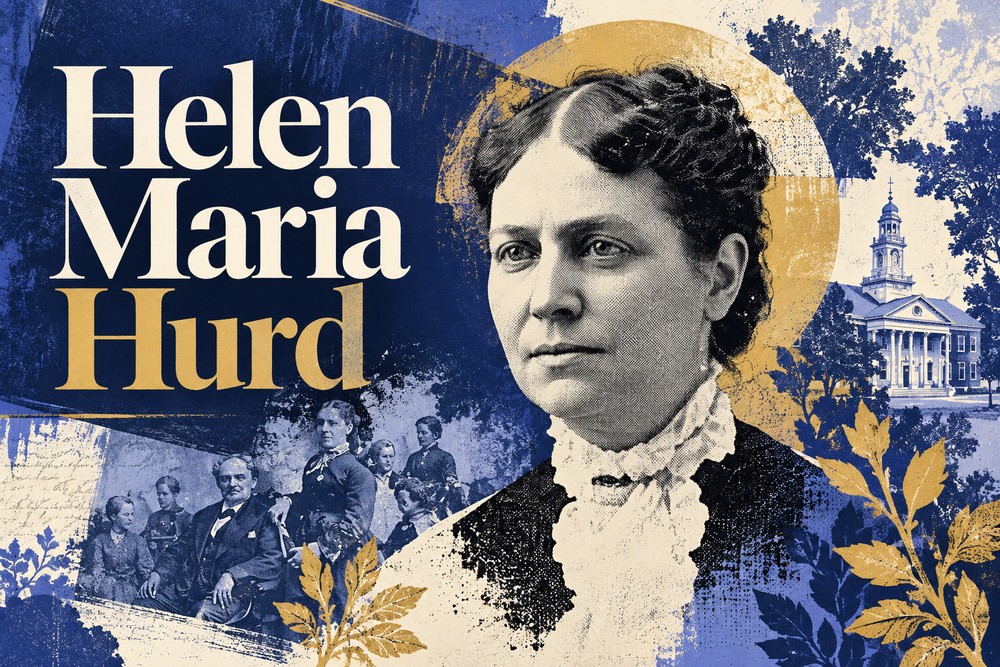
I keep circling back to Helen Maria Hurd. She was born Helen Maria Barnum on 18 April 1840, second daughter of Phineas Taylor Barnum and his first wife, Charity Hallett. Genealogies place the birth in New York City, Danbury, or Bridgeport.
A Childhood Inside the Museum Lights
Helen grew up while her father’s reputation gathered steam. Barnum’s American Museum drew crowds, and the traveling circus that would carry his name was taking shape. The Iranistan house was full of noise, posters, and strangers at the door. As a young woman she was a guest of honor at President Ulysses S. Grant’s first inaugural ball.
Her mother had four daughters. Caroline Cornelia arrived in 1833 and lived until 1911. Frances Irena was born in 1842 and died two years later. Pauline Taylor, born in 1846, married Nathan Seeley and died in 1877. Four girls, two taken early.
Marriage at Seventeen to Samuel Henry Hurd
On 20 October 1857, barely seventeen, Helen married Samuel Henry Hurd at the home of her sister Caroline, in or near Bridgeport. Hurd owned a leather business and soon became treasurer and assistant manager of Barnum’s circus. A man married into the tent, then handed the ledgers. Within five years came three daughters, Helen in 1858, Julia in 1860, and Caroline in 1862.
The Divorce of 1871 and a Second Vow
In 1871 Helen divorced Hurd, a step that scandalized her circle and put her at odds with her father, though the two stayed personally close. Custody of the three girls went to their father.
She did not stay alone. In March 1871 she married Dr. William Harmon Buchtel in South Bend, Indiana. He was born in Akron, Ohio, in 1845, a physician, real estate developer, and mining investor, and the brother of Henry Augustus Buchtel, chancellor of the University of Denver and later governor of Colorado. Tuberculosis drove the couple west, and Denver became the pharmacy.
Forty Four Years in Denver
Helen lived in Denver for about 44 years. She joined the Daughters of the American Revolution, sat on the board of the Denver Orphans’ Home and helped endow it, and was a fixture at St. John’s parish. Contemporaries credited her with executive ability and force of character, which I read as code for a woman who got things done while wearing a very good hat. She and William had at least two daughters, Lelia, later Mrs. Fred Chamberlain of Denver, and Pauline, who died at about two years and seven months.
The Land Southwest of Denver
The Colorado chapter has a property line running through it. In March 1878 Barnum bought roughly 760 acres southwest of Denver for $11,000 from the failed Denver Villa Park Association. The ground was wet and poorly drained. Locals joked that if you stick with Barnum, Barnum will stick with you. Around 1884 he transferred the remainder to Helen for a nominal one dollar, and the parcel was platted as the P. T. Barnum Subdivision. William served as mayor of the short lived independent Town of Barnum, incorporated in 1887. Denver annexed the town in stages, in 1893 and 1896, and absorbed it fully by 1902.
Much of the land was sold, yet Helen kept significant interests. At her death she was described as the sole surviving direct heir of Barnum still holding meaningful ties to that property. Barnum himself never lived in Denver. He made four documented trips to the state, in 1870, 1872, 1877, and 1890, and the legend that he wintered circus animals there is false. The neighborhood name is the monument.
The Hurd Daughters and Their Roads
The three girls raised by their father each found a different door. Helen Barnum Hurd Rennell, 1858 to 1933, married Francis William Thornton Rennell, a stock exchange member, and became active in Connecticut charities. Julia Caroline Hurd Clarke, 1860 to 1894, married Henry Peck Clarke, moved to South Carolina, and gave birth to Nancy Barnum Clarke Carrier, founder of Rockbrook Camp. Caroline Thompson Hurd, born 1862, died in 1883.
The Last Shopping Trip
On 11 December 1915, at her home at 635 Emerson Street in Denver, Helen died at seventy five after a sudden attack of grippe and heart disease. She had been out shopping the day before. A woman of seventy five, still buying things. She was buried in Fairmount Cemetery.
| Relation | Name | Dates |
|---|---|---|
| Father | Phineas Taylor Barnum | 1810 to 1891 |
| Mother | Charity Hallett Barnum | 1808 to 1873 |
| First husband | Samuel Henry Hurd | c. 1827 to 1898 |
| Second husband | Dr. William Harmon Buchtel | 1845 to 1912 |
FAQ
Where was Helen Maria Hurd born?
New York City, Danbury, and Bridgeport all appear in genealogies and obituaries, though every account agrees on the date, 18 April 1840.
How many children did Helen Maria Hurd have?
Five that the record names. Three daughters arrived during her first marriage, Helen, Julia, and Caroline, and two during her second, Lelia and Pauline. Pauline Buchtel died at about two years and seven months.
Why did the divorce of 1871 cause such a stir?
Divorce was rare and socially radioactive then, and Helen left a husband who worked inside her father’s own circus. Custody went to Samuel Hurd, and the scandal strained her relationship with P. T. Barnum even though the two remained fond of each other.
What happened to the Barnum land in Denver?
It became the Town of Barnum, incorporated in 1887 with William Buchtel as mayor, then joined Denver in stages between 1893 and 1902. Today the Barnum and Barnum West neighborhoods carry the name.
Where is Helen Maria Hurd buried?
In Fairmount Cemetery in Denver, the city she called home for roughly 44 years.