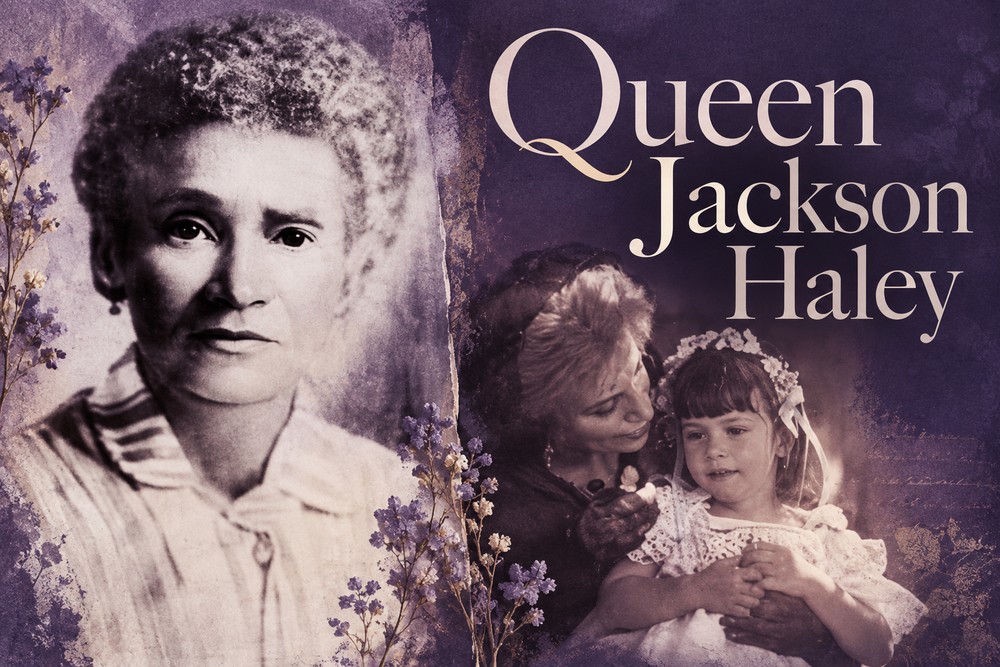
I keep returning to a single picture of her. A small woman kneeling in the dirt of a Tennessee garden, coaxing elephant ear plants wider than her hands, saying something sharp and funny to whoever stands nearby. That is how I like to imagine Queen Jackson Haley. Not as a footnote in someone else’s famous book, but as a woman with soil under her nails and a joke on her tongue.
Born on the Forks of Cypress
She arrived on April 8, 1858, in Lauderdale County, Alabama, on the Forks of Cypress plantation. Her father was James “Jass” Jackson III, a wealthy white planter who also served as a Confederate lieutenant colonel, an Alabama state senator, and a probate judge. Her mother was Easter, an enslaved weaver described as light skinned, with possible Cherokee and African ancestry. She was born into her father’s world while standing legally outside it.
A Childhood of Proximity and Denial
Easter died around 1860 and was buried in the plantation cemetery. Queen was barely two. What followed was a childhood stitched from nearness and refusal. She served as a domestic servant to her half sisters, the legitimate Jackson daughters, girls who shared her blood and not her name. Imagine polishing the shoes of children who were told you were nothing to them.
Freedom With No Door Open
The Civil War ended in 1865, and emancipation arrived like a key that fit no lock. James Jackson refused to acknowledge her, fearing scandal and inheritance disputes. Queen was cast out without support, and the years that followed were, in family memory, a run of unpleasant adventures.
By the mid 1870s she had moved to Savannah, Tennessee, in Hardin County, and found work as a housegirl and cook at Cherry Mansion, the estate of the Cherry family, Unionists whose home had hosted General Ulysses S. Grant during the Battle of Shiloh. The work was menial but it gave her a foothold.
The Language of Flowers and a Mind Under Strain
People in Savannah remembered her as petite, smart, and quick with a memorable saying. Her flowers and elephant ear plants became local legend. I think of that garden as her private country, the one place where she decided what would grow.
She experienced what neighbors called spells, periods of mental distress that led to time at a hospital in Bolivar. I do not read that as weakness. I read it as the bill for a childhood spent being loved and denied in the same breath.
October 9 1881 A Marriage That Steadied the Ground
On October 9, 1881, Queen married Alexander “Alec” Baugh Haley in Hardin County. Alec had been enslaved, carried possible Scottish ancestry through DNA links to the overseer William Harwell Baugh, and ran a successful ferry across the Tennessee River. The marriage was his second, after his union with Cynthia, and Queen became stepmother to Julie, Minnie, Emma, and Freelan Haley. For a woman pushed out of every door, a house of her own must have felt like a small miracle.
The Children Who Carried Her Forward
| Child | Born | What I Notice |
|---|---|---|
| Abner Jackson Davis | September 5, 1881 | Migrated to Detroit |
| Conway Welsh Haley Sr. | December 8, 1888 | Raised in Savannah |
| Simon Alexander Haley | March 8, 1892 | Professor, father of Alex Haley |
| Annie Wilks | Unknown | Married James R. Wilkes |
Simon became the family’s academic engine, earning degrees from Lane College and Cornell and serving as a dean at Alabama A&M. Through him, Queen became grandmother to Alex Haley, the writer, and to George W. Haley, a lawyer, Julius Haley, an architect, and Lois Haley. Every degree in that list is a door she never got to open herself.
Work Money and the Ledger of Survival
Her working life fit inside the narrow channel allowed to Black women of her era. She was a servant during slavery and a domestic worker afterward. Money stayed thin. Alec’s ferry income gave the family stability, though no record shows wealth piling up. Some accounts say she owned a store in her later years, a counter of her own after decades in other people’s rooms.
Widowhood Census Records and Florence
Alec died before 1920. The 1920 census places Queen in Corinth, Mississippi, living with Abner. By 1940 she may have been in assisted living in Florence, Alabama. She died in June 1941 at age 83 and was buried in Savannah Cemetery.
The Story That Outlived the Silence
Alex Haley, who lived from 1921 to 1992, turned his grandmother’s life into the novel Queen, completed by David Stevens after his death. The 1993 miniseries starred Halle Berry and won Emmys for costuming and hairstyling. Beauty in that era was always partly about what a person is forced to wear, whether a servant’s apron or a name that was not quite hers.
FAQ
Who was Queen Jackson Haley?
She was a woman born into slavery in Alabama in 1858, the daughter of a white plantation owner and an enslaved weaver, who later built a life in Savannah, Tennessee, as the grandmother of the author Alex Haley.
Who were her parents?
Her father was James “Jass” Jackson III, a planter, Confederate lieutenant colonel, Alabama state senator, and probate judge. Her mother was Easter, an enslaved weaver who died around 1860.
How many children did she have?
Her children were Abner Jackson Davis, Conway Welsh Haley Sr., Simon Alexander Haley, and Annie Wilks. She also raised four stepchildren, Julie, Minnie, Emma, and Freelan Haley.
What was her relationship to Alex Haley?
She was his paternal grandmother, and he based the novel Queen on her life.
When did she die and where is she buried?
She died in June 1941 at age 83 and is buried in Savannah Cemetery in Tennessee.